Get Familiar: spazioSERRA
Interview by Passion Dzenga and Liesje Verhave | Imagery courtesy spazioSERRA
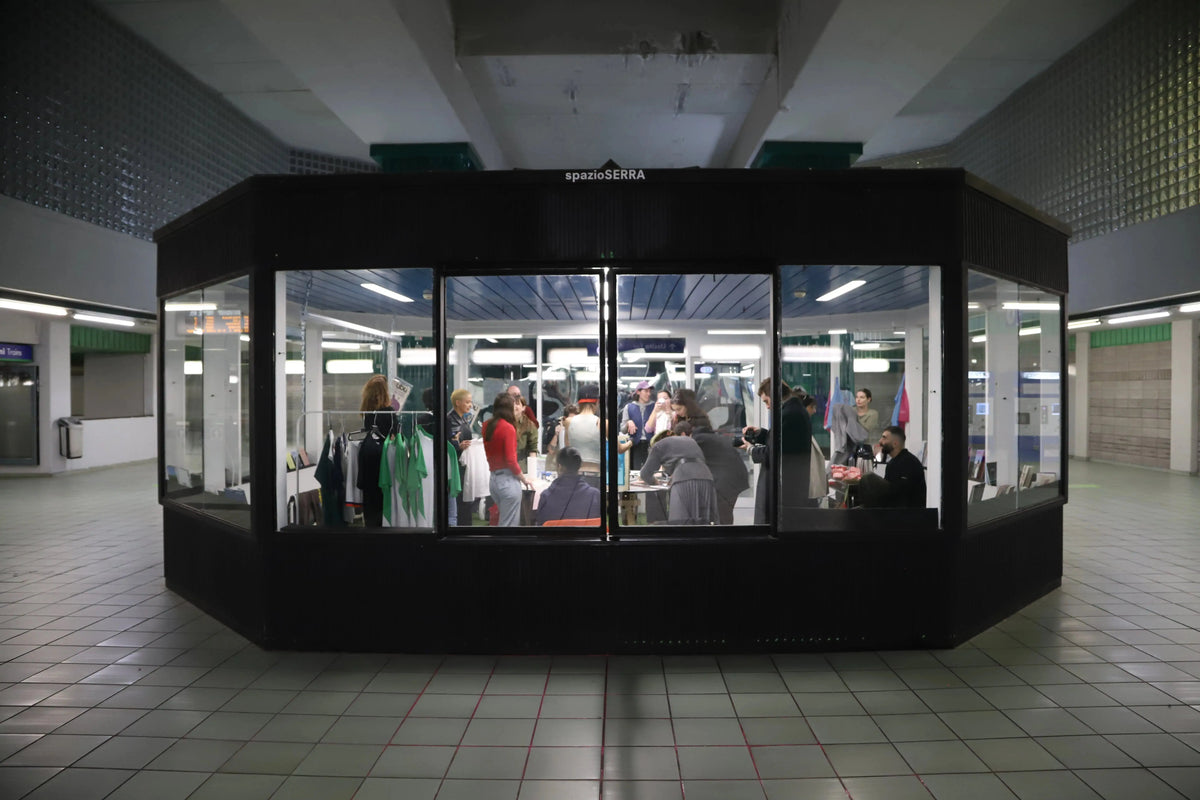
Most galleries ask people to come to them. spazioSERRA asks something different. Hidden inside Milan's Lancetti railway station, the independent exhibition space exists in a place designed for movement rather than contemplation. Every day, commuters, students, families and local residents pass through its doors, often encountering contemporary art entirely by accident.
That tension has shaped the collective's practice since its founding. Rather than treating the station as simply another venue, spazioSERRA has embraced it as both subject and collaborator. Here, exhibitions are conceived specifically for a public in transit, where artworks compete with train announcements, morning routines and the constant rhythm of the city itself. There is no white cube, no controlled viewing experience and no expectation that visitors arrive already interested in contemporary art. Instead, every exhibition begins with a simple question: what happens when art interrupts everyday life?
We spoke with the spazioSERRA collective about nearly a decade of working inside a railway station, developing a curatorial practice rooted in site-specificity, and why they believe public art should never be neutral.

spazioSERRA has always existed inside a railway station rather than a traditional gallery. Why was that important from the beginning?
The station has never simply been a venue for us. From the very beginning, it was the starting point for the entire project. Rather than asking how we could fit contemporary art into a railway station, we were interested in understanding what kind of exhibitions could only exist in a place like this. The context changes everything. A station is designed for movement, transition and routine. People aren't there because they've decided to spend an afternoon looking at contemporary art. They're commuting to work, heading home, meeting friends or simply passing through.
That completely transforms the relationship between the artwork and its audience. In a traditional gallery, visitors have already made a conscious decision to engage with an exhibition before they even walk through the door. They arrive prepared to spend time looking, reading and reflecting. Here, that expectation disappears. Most people encounter the exhibitions unexpectedly. Some only glance at them while waiting for a train. Others return every day as part of their commute and slowly build a relationship with the work over weeks or months without even realising they're doing so.
For us, that's incredibly exciting because it means the exhibitions become part of everyday life rather than something separate from it. During the pandemic, for example, many museums and galleries were closed, but because our exhibitions were visible from the station itself, people could continue experiencing contemporary art simply by moving through the city. That reinforced something we'd always believed: art doesn't need to exist inside isolated cultural institutions. It can become another layer of the urban landscape, living alongside the rhythms and routines of the people who pass through it every day.
Your audience is often accidental rather than intentional. How does that change the way you think about curating exhibitions?
It influences almost every curatorial decision we make. Unlike a museum or commercial gallery, we can't assume that our audience already has an interest in contemporary art or even knows who the exhibiting artist is. Most visitors didn't wake up planning to see an exhibition. They're simply moving through the station as part of their daily routine. That means we have to think very carefully about how somebody encounters the work for the first time.
Accessibility is important to us, but we don't think of accessibility as simplifying ideas. Instead, it's about creating multiple points of entry. Someone who only has thirty seconds before their train arrives should still be able to connect with something visually or emotionally. At the same time, somebody who returns every day for a month should continue discovering new layers, new references and new meanings each time they encounter the work.
That creates a very different kind of exhibition design. We think about sightlines, movement through the station, how the architecture frames the work and how people experience it from different distances. The audience isn't standing still. They're constantly in motion. The exhibitions have to acknowledge that movement rather than resist it.
What's particularly interesting is that people begin creating their own relationships with the exhibitions over time. Some commuters see the same installation every morning on their way to work and every evening on their way home. Without necessarily intending to, they become long-term spectators. Their understanding develops gradually through repetition rather than through a single dedicated visit. Site-specificity seems to be central to your programme.

How do artists respond differently when they know their work will exist in a public space?
That's one of the reasons artists are often excited to work with us. We don't invite people to simply install an existing body of work inside the station. We ask them to begin with the station itself. The architecture, the movement of people, the visibility of the space and the surrounding neighbourhood all become part of the conversation before a single artwork is made.
That process often changes the work dramatically. Instead of treating the exhibition as something independent from its surroundings, artists begin responding directly to the environment. Sometimes the architecture becomes part of the installation. Sometimes the public becomes part of the work. Sometimes the exhibition only makes sense because it's happening in that precise location.
Over the years, we've realised that there isn't really a clear boundary between the artwork and the station anymore. The two continuously influence one another. The work transforms the space, but the space also transforms the work. The audience completes that relationship because every person experiences the exhibition differently depending on where they're coming from, how much time they have, and what they're bringing with them emotionally that day. For us, that's what site-specific practice really means. It's not simply adapting something to fit a location. It's allowing the location itself to become an active collaborator in the exhibition.
This year's programme is titled Co-presence Is a Passing Gesture. What does that phrase mean to you?
The title emerged quite naturally once we began looking at all of the selected projects together. Originally, we approached this season differently from previous years. Rather than establishing a broad curatorial theme and asking artists to respond to it, we opened the call without prescribing a subject. We wanted to understand what artists themselves were already thinking about and what kinds of questions felt urgent to them.
After selecting the projects, we started noticing unexpected connections. Again and again, artists were exploring ideas around spectatorship, participation, waiting, public space and the different ways people occupy environments together without necessarily interacting.
A railway station became the perfect place to think about those ideas because it is fundamentally a place of co-presence. Thousands of people share the same physical environment every day. They're together, but they're rarely connected. They're passing one another constantly without necessarily acknowledging one another's existence.
The exhibitions each approach that condition differently. Some invite participation. Others ask people to observe. Some explore waiting as a political condition, while others think about performance, intimacy or memory. What connects them all is this idea that relationships can exist even if they're brief, temporary or almost invisible.
In many ways, that's exactly what happens inside the station every single day. It shows that these ideas are being tested through the exhibitions themselves.

The exhibitions this season all seem to approach co-presence from different perspectives. Could you tell us about some of the recent projects and how they connect to the wider programme?
One of the things we've been interested in throughout this season is how each artist approaches the idea of co-presence differently. Rather than illustrating the concept directly, every exhibition has explored a different relationship between the artwork, the audience and the public space of the station.
Joan Horrach's installation was a good example of that. The work centred on waiting, but it wasn't simply about representing waiting as a theme. Instead, it mirrored what was already happening inside the station. The installation resembled a waiting room that could easily have belonged to the railway station itself, blurring the boundary between the exhibition and everyday life. People waiting for trains became part of the work without necessarily realising it, while the work itself reflected the rhythms, routines and temporary encounters that already define the station. In many ways, it asked visitors to recognise that waiting isn't an interruption to public life but one of its fundamental conditions.
Valerio Torrisi's exhibition approached waiting from a much more personal and political perspective. Through a long-duration performance, he explored the ongoing struggle for LGBTQ+ rights in Italy, particularly the fact that same-sex couples are still denied full marriage equality. Rather than presenting this through explicit political messaging, he built the work around the poetic image of a partner waiting for a wedding that never arrives. Throughout the exhibition, the flowers within the installation slowly decayed, becoming a physical measure of time passing without resolution. That gradual transformation reflected both the emotional exhaustion of waiting and the reality that progress, while happening, often feels painfully slow for the communities directly affected.
What interested us most about Valerio Torrisi's project was the way it embodied these ideas rather than illustrating them. Visitors didn't necessarily arrive knowing when the performer would appear or even exactly what they were waiting for. They found themselves sharing that uncertainty with the work itself. The performance resisted fixed identities and clear definitions, allowing the body, language and duration of the piece to communicate experiences that couldn't easily be reduced to a single statement or slogan. In that sense, it became less about explaining LGBTQ+ rights and more about allowing people to inhabit, even briefly, the emotional condition of waiting for recognition.
The unpredictability of public space makes these encounters especially meaningful. We can carefully consider how an exhibition is installed, how it addresses the architecture and how people might move through it, but we never truly know how the public will respond. Sometimes an installation encourages immediate participation. Other times people simply walk straight past. With Fidaty Collective's football field installation, for example, we initially thought the project wasn't working because nobody wanted to engage with it. Then, unexpectedly, a group of visitors stayed for almost an hour playing together. Those moments remind us that public space always resists complete control. The audience ultimately completes the work in ways that can't be anticipated.

Looking ahead, the final exhibitions continue expanding these ideas in new directions. What can visitors expect from the remainder of the programme?
The next projects continue exploring spectatorship and participation, but each approaches those ideas through very different forms. The next exhibition is by Elisi’s collective, whose practice sits somewhere between design, research and installation. Their project introduces the idea of the "mnemosphere," a term they developed to describe the relationship between atmosphere and memory. Rather than presenting a series of individual snow globes, the installation transforms the entire space into a boule à neige. What makes the work particularly interesting is that it only becomes active through the movement of visitors passing by the space.
Hidden sensors respond to the presence of commuters, generating bursts of movement that cause the snow throughout the space to swirl. Most visitors won't even realise they've activated the installation. They're simply walking through the station as they always would. That invisible participation perfectly reflects the wider theme of the season. Whether intentionally or not, people continuously shape the exhibition simply through their presence. We hope that for those who stop to spend more time with the work, these moments of activation begin to open up more personal reflections around memory, atmosphere and the ways our environments quietly influence our emotional lives.
The final project, by Sveva Crisafulli, moves in a completely different direction. Through a performance and accompanying editorial publication, she investigates the practice of cake sitting—a subject that initially surprised us because none of us were familiar with its history. As we began researching the project together, we realised it opened up much broader conversations around the body, sexuality, food, spectacle and feminist theory.
Rather than treating cake sitting as an isolated or sensational act, Sveva traces its cultural history from the Renaissance through to contemporary internet culture, asking what this unusual practice reveals about desire, consumption, performance and the ways bodies are viewed in public. Unlike many of our previous exhibitions, this project invites audiences directly into the exhibition space itself, creating a shared encounter rather than one experienced solely through the station windows.
Although the two exhibitions are formally very different, they continue the same conversation that has shaped the entire season. Both ask how people participate in artworks, whether consciously or unconsciously. Both question the relationship between spectatorship and embodiment. And both remind us that contemporary art doesn't simply exist to be looked at. It creates situations where audiences become active participants, sometimes without even realising it.
After nearly a decade, spazioSERRA has demonstrated that contemporary art doesn't need the neutrality of the white cube to have an impact. If anything, its power is amplified by the unpredictability of public life. Within the constant movement of Milan's Lancetti station, exhibitions become part of the city's rhythm rather than an escape from it. They ask commuters to pause, if only briefly, and reconsider the spaces they move through every day.
Throughout our conversation, one idea surfaced repeatedly: relationships. Relationships between artworks and architecture, artists and audiences, strangers sharing the same space, and the fleeting moments of attention that connect them. Whether through Joan Horrach's reflections on waiting, Valerio Torrisi's meditation on queer recognition, Elisi’s collective’s invisible interactions with memory or Sveva Crisafulli's exploration of bodies, intimacy and spectatorship, every exhibition extends the same conversation. Rather than presenting finished conclusions, they create situations where meaning emerges through encounter.
In a city that often prioritises speed, efficiency and constant movement, spazioSERRA offers something increasingly rare: permission to linger. Even if that pause lasts no longer than the time it takes for a train to arrive, the collective hopes that moment of interruption is enough to shift someone's perspective. The station remains a place of transit, but for a few seconds, it also becomes a place of reflection.
Ultimately, that's what spazioSERRA has been building all along. Not simply an exhibition space inside a railway station, but a cultural landmark embedded within everyday life, one that reminds us that art doesn't always ask us to step outside the city. Sometimes, it simply asks us to see it differently.